INCA GOLD F104
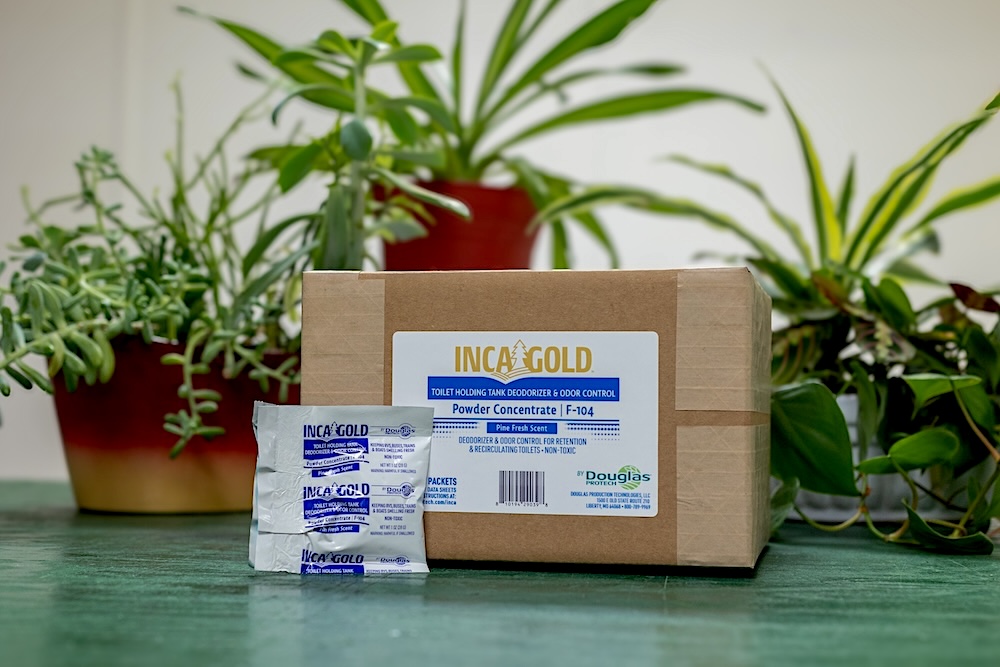
INCA GOLD F104 is a blue deodorant powder that contains active ingredients that readily dissolve in water to form an easily handled deodorant solution for use in the widest range of retention toilet systems.
- Non-formaldehyde, ready-to-use, concentrated formula
- 100% Biodegradable – Completely safe for discharge into sewage treatment facilities
- Pleasant & airy scent
Learn More at Douglas ProTech
APPLICATION GUIDELINES
Inca Gold Powder - Concentrated Toilet Deodorizer & Odor Control F-104
Inca Gold Powder - Concentrated Toilet Deodorizer and Odor Control formula has active ingredients that dissolve in water to form an easy-to-use solution for use with a wide range of toilet systems, including retention toilets, recirculating toilets, and pit and vault toilets.
DOSAGE: A 1-oz dose of Inca Gold Powder Concentrate is formulated to service a typical 40-gallon retention toilet with black water holding tank at 70°F. For other size holding tanks, adjust dosage accordingly. For temperature conditions, see dosage notes below.
Retention Toilet Application Guidelines
When using Inca Gold Powder in a typical retention toilet with a black water holding tank:
RINSE AND PREPARE HOLDING TANK - Ensure that both toilet and holding tank are thoroughly emptied, cleaned and rinsed before adding product.
ADD INCA GOLD - As you pour 2-3 gallons of fresh water to the toilet and holding tank, slowly drizzle the contents of a 1-oz packet of Inca Gold Powder into the water stream. Inca Gold Powder is highly concentrated and should always be mixed with sufficient water to completely dissolve and reach the holding tank. Read notes on conditions below.
Recirculating Toilet Application Guidelines
Since toilet capacity varies for recirculating toilets, the amount of product required will vary based on individual toilet capacity to ensure flush fluid odors are adequately masked.
Follow the application instructions for retention toilets but first:
DETERMINE TOILET CAPACITY - Determine the total capacity of your toilet in gallons. The larger the recirculating toilet capacity for collected wastes, the more product needed.
DETERMINE PRODUCT AMOUNT - A minimum ratio of 2 oz. Inca Gold Powder per 5 gallons precharge is recommended for recirculating toilets. Read notes on conditions below.
Pit & Vault Toilet Application Guidelines
Odor management is unique for pit and vault toilets because complete pump-out may not occur for prolonged intervals. Substantial evaporation of fluids can occur, exposing solid wastes to the air and preventing the deodorant compounds to operate optimally in its liquid form. Because of this, Inca Gold Powder is recommended to be used in both its liquid and powder forms:
ADD CONCENTRATED LIQUID TO VAULT WALLS - After pumping the pit/vault toilet, a concentrated product solution should be prepared: 20 oz. (1 ¼ lbs) or more of Inca Gold Powder per 5 gallons of water. Coat this solution on the walls and bottom of the pit/vault to form an odor barrier.
ADD LIQUID PRECHARGE - Maximum odor control is achieved when wastes remain covered by a liquid solution of Inca Gold to ensure complete dispersal and contact between the deodorizer product and wastes. Mix a 1-oz packet of Inca Gold Powder with 5 gallons of fresh water as a "precharge", or premixed solution. This ensures the product is fully dissolved before adding to the toilet holding tank to work at maximum efficiency. This suggested starting amount is a general guideline for odor control; based on experience with the waste volume of your vault, add more as applicable.
ADD ADDITIONAL LIQUID AND/OR POWDER TO SURFACE - Ideally, add additional liquid precharge to the vault periodically. But if excessive evaporation exposes solid wastes, the powder product can be sprinkled directly on the solids.
Notes for All Toilet Types
CONSIDER CONDITIONS - The amount of product required for each system is dependent on multiple factors, including mean temperature, holding tank size, period before next service, and actual waste volume, which all impact the amount of product needed for adequate odor management. Exact amounts are best determined from experience with each individual system.
For temperature as a rule, the rate of biological reaction doubles for each increase of 10°F, so it is recommended to double the amount of product added with every 10°F increase above 70°F, for effective odor control.
For example, for 20-30 gallons of waste to be collected over a 7-day collection period:
- For temperatures at or above 80°F (27°C), add 2 ounces of product to the water stream.
- For temperatures at or above 90°F (35°C), add 4 ounces of product to the water stream.
DISPOSAL - Inca Gold products are non-toxic, free of formaldehyde or other harmful chemicals, and approved for disposal wherever dumping is allowed.
SANITATION - While Inca Gold may be one of the most powerful toilet deodorizers on the market, it is not to be used as a sanitizer. For your safety, please practice hygienic ownership of your portable toilet system.
Find Safety Data Sheets and instructions for all Inca Gold products at douglasprotech.com/inca.